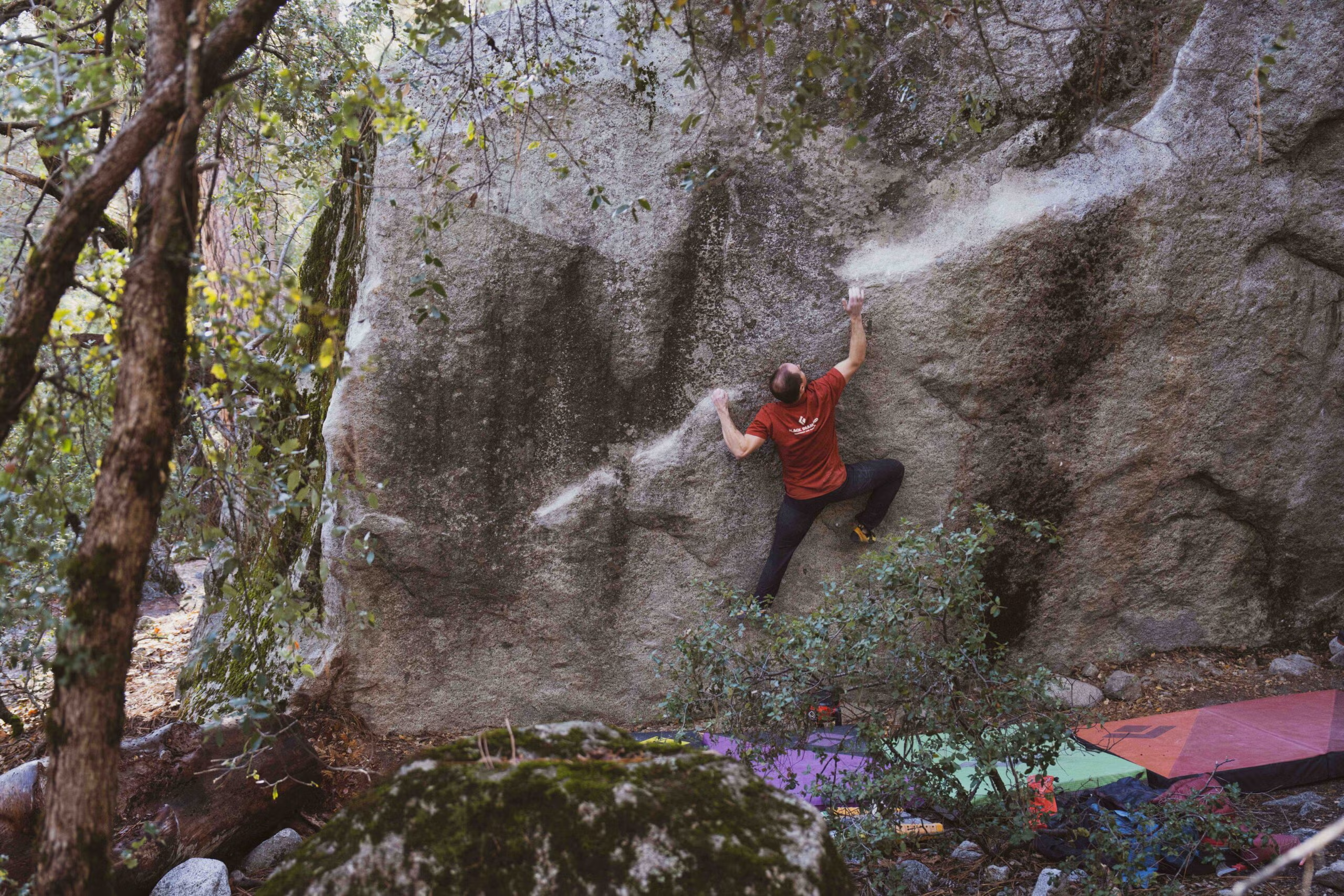
James Ratcliffe Magnesius (Jim Rat Mag, to his friends), listening to “NEVER ENOUGH” by Turnstile and getting psyched for a session.
Welcome to Gym Rat, the world’s first-ever indoor climbing newsletter!
Hi readers,
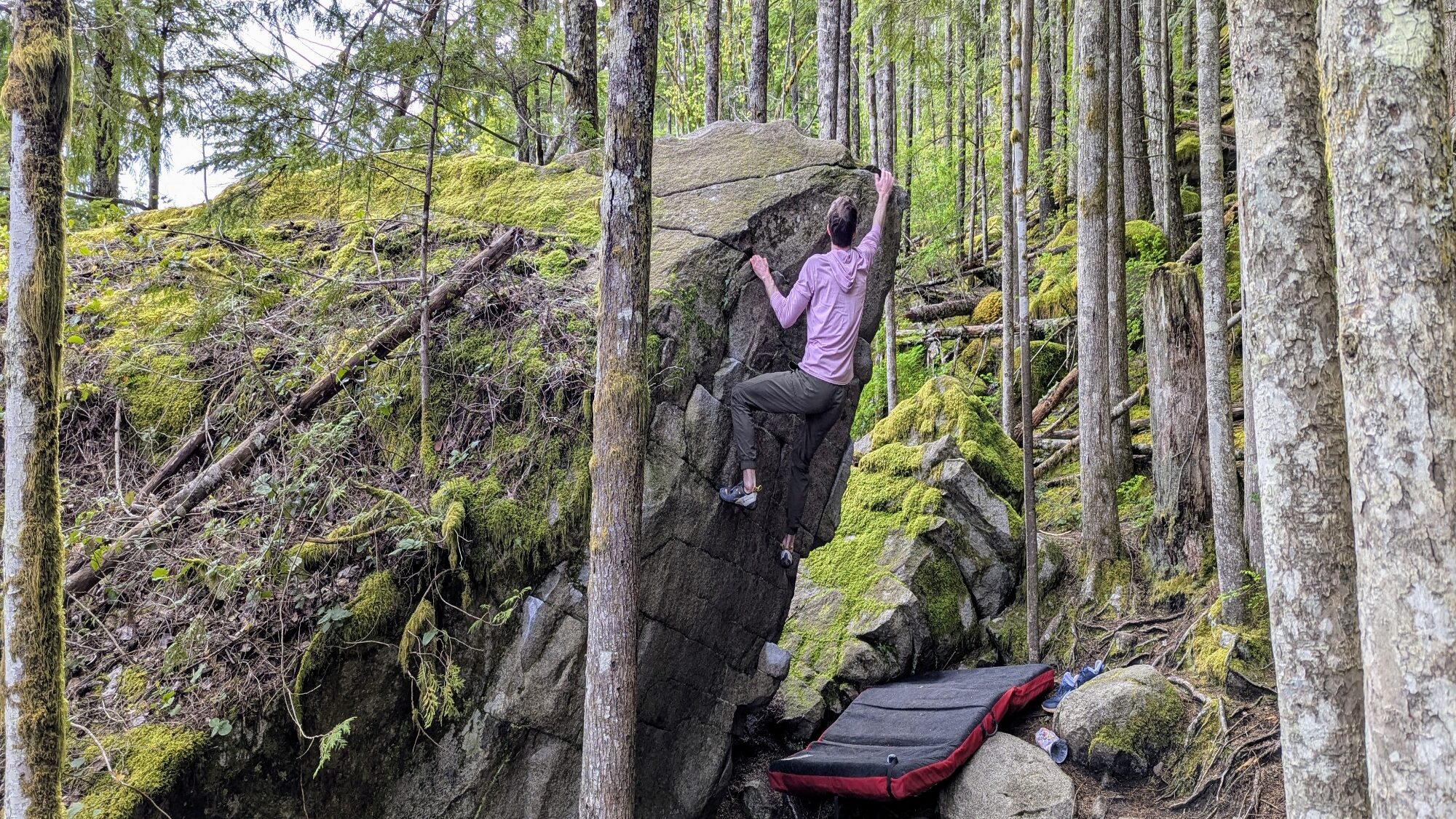
This project came about because I (your editor, Callie) am bad at directions and became very confused while attempting to locate the boulders in New York City’s Fort Tryon Park. After an embarrassing amount of wandering, I managed to spot one, largely because of the crashpad-spread and chalky climber beneath it. When I asked this climber if he could please help me, he pulled out his phone and showed me the locations of all the park’s problems in a well-appointed, user-friendly app— which he just so happened to help create. We got to chatting and touched on how large climbing has grown, and how it can sometimes feel hard to know each other in such an expansively evolving community. Someone said the word “newsletter,” email addresses were exchanged, and a few weeks later, we had a plan.
So, I met a guy in the woods, and now here we are. The beauty of climbing. I’m very proud to introduce a menagerie of lives and stories all connected through this weird and wonderful world. I hope you enjoy it so that we get to do more of this.
x Callie
Climbing Tamales – by Oren Karp
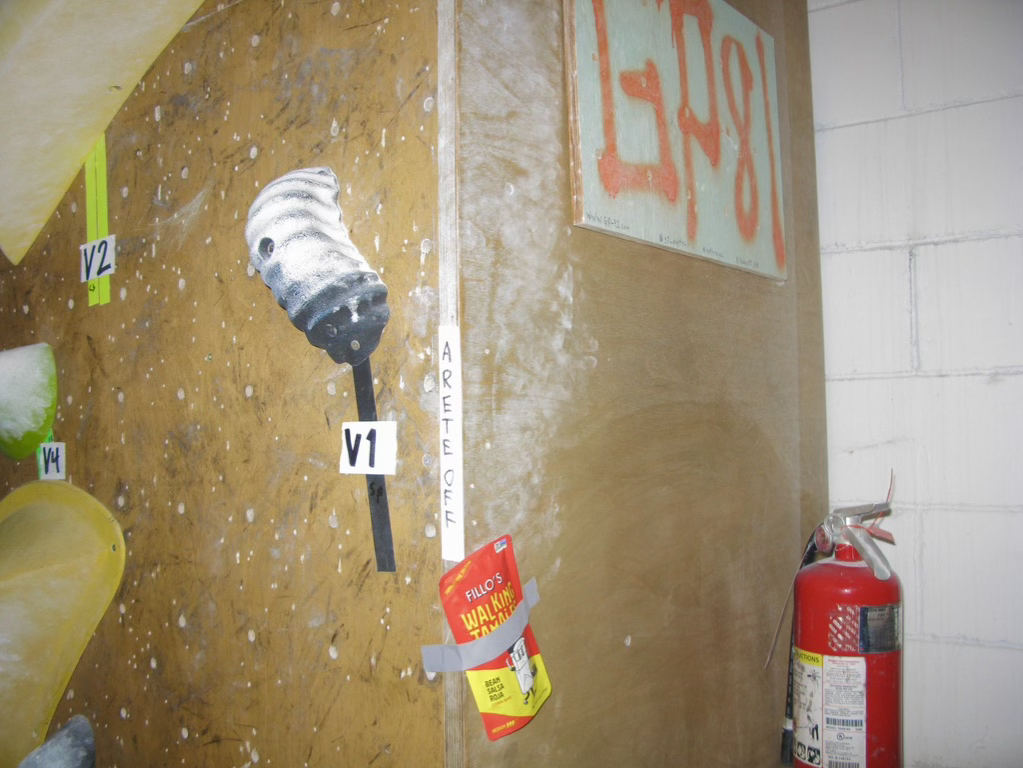
When we asked GP-81, New York City’s independent climbing gym, if they would host a tamale hunt to promote our new climbing magazine, Vermin, they accepted as if it were a normal thing to suggest. The idea had actually come from Fillo’s, the company that makes the “Walking Tamales” and loves finding creative ways to share their brand. They’re a natural fit for climbers: individually packaged in bright yellow with cute illustrations that offset any (admittedly reasonable) skepticism about the concept of a shelf-stable tamale. As huge fans of their products, we were flattered when they agreed to sponsor our magazine, and when they proposed this event, we thought it was a perfect fit for our community. We couldn’t say no.
We got to the gym around 3:00, as the setters were starting to finish up on the 60º. I borrowed my roommate’s car, which was really what made it possible, since the alternative would have involved multiple trains with more large cardboard boxes than I have arms. It took a couple of trips to get all the boxes inside. The gym was still full of midday quiet.
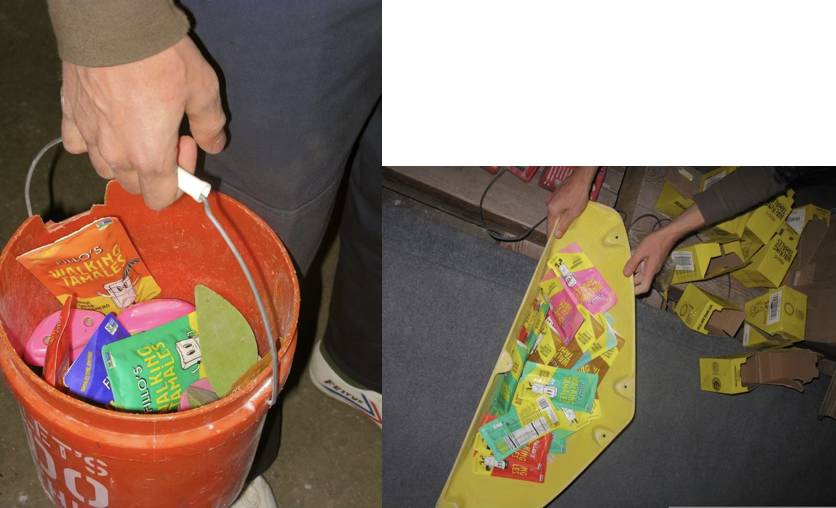
First things first: a photoshoot with the tamales and the setting tools. Milk crates and 5-gallon buckets full of foot chips and tamales. A sloper filled with tamales, screwed into the wall, and then unscrewed to let them fall to the mat in a heap. Tamales balanced on holds. Rainbows of tamales on the grey, chalky pads.
Then, business. The setters provided tape, and we took turns climbing to the top of the wall and taping tamales among the holds. Our technique involved one person on the ground, pre-taping the tamales and tossing them one at a time to the person traversing the wall. After half an hour and a surprising amount of pump, the walls were covered with tamales, and we were ready to go.
The after-work rush started, and soon the gym was filled with the familiar hum of a new set on a winter evening. We arranged our magazines on a table and stood on a trash can to announce that the tamales covering the gym walls were, in fact, free for the taking. We were met with tentative understanding and scattered applause.
What followed wasn’t the mad rush that we had expected, but slowly, climbers started grabbing tamales off the wall. Some tried to snag them as they climbed, while others threw them to the ground, kept climbing, and collected their prize off the mat. People playfully teased each other and stockpiled different flavors with their friends. Hesitant initial bites were followed by grins, followed by larger bites. No one was climbing hungry.
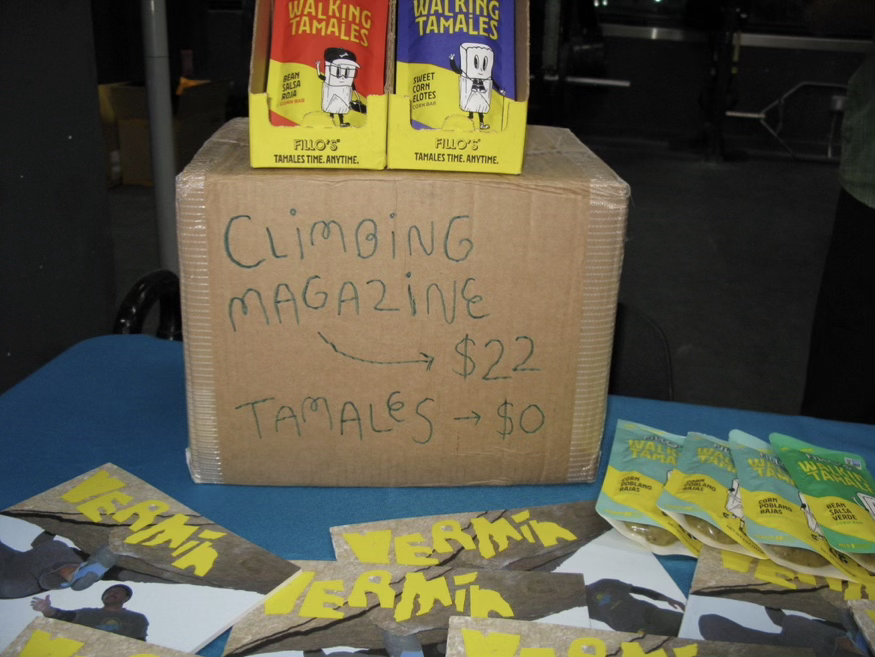
There seemed to be an unspoken rule that everyone followed: no taking a tamale unless you sent. I understood it, as I think any climber would. The tamale had to be earned. At the same time, it wasn’t about sending at all—the tamales gave everyone something to climb for besides the top, which we don’t often get. That chance to shift my focus away from sending turned out to be a gift, and led to one of the most lighthearted, fun nights of climbing I’ve had. Didn’t send? Who cares! Grab a tamale.
In the end, there was something so visually unserious about dozens of tamales taped to a wall that I couldn’t help but think maybe climbing wasn’t so serious, either. The more I thought about it, the less it mattered what grade I was working. All that mattered was reaching that sweet, sweet tamale on the wall and brandishing it victoriously over my head when I jumped down. The climbing, for once, was just a way up the wall.
###
Oren is the editor at Vermin, a great print climbing magazine coming out of Brooklyn—think early-days Urban Climber, with less sexism and more paper quality. Get inspired by @verminworld on Instagram, order a copy of the first edition from their website, verminmag.square.site, then capture your ethereal climbing memories in the written word and pitch them to Vermin!
The Only Place I Stop Trying to Be Someone- by Christopher Rivas
I don’t think my mind has ever wanted to be nobody.
It has always wanted to be someone – someone impressive, someone loved, someone chosen, someone understood, someone seen. As an avid meditator, I know that even in stillness it performs. Even in silence it narrates. Even in meditation it peeks one eye open to check if enlightenment is watching.
But twelve feet off the ground, fingers crimped on a hold the size of a cough drop, something strange happens… The voice disappears.
Not quiets. Not softens. Disappears.
Because the wall does not care who I am. It doesn’t care what I’ve written or who’s read it. It doesn’t care about followers or fellowships or whether I was the only Brown kid in the room growing up. It doesn’t care about the version of masculinity I was handed or the one I’m still trying to unlearn. It doesn’t care about productivity or performance or proof. The wall has no interest in my résumé or Wikipedia page.
It only asks: Can you listen?
Climbing, especially bouldering, is a conversation disguised as a problem.
They even call routes problems, which feels like the most honest language I know. You don’t conquer a problem. You don’t dominate it. You study it. You circle it. You fail it. You sit beneath it like a student who finally understands that the lesson is not passing, the lesson is attention. As the great poet and sage Mary Oliver says, “Where we put our attention, reveals our devotion.”
A climb is human chess. Left foot here means right hand next. Hip shift now means balance later. Rest too long and risk your friction. Don’t rest enough, you burn out. Rush and you lose breath. Lose breath, lose everything.
Everything matters. Everything listens back. And so you learn to listen deeper than ambition. You learn to focus your attention. You learn how to devote yourself to this moment.
Not listening like just waiting for your turn to speak. Listening like your body is an ear.
The wall tells you where you are tense. The wall tells you when you are lying. The wall tells you how much your ego weighs. Mine – a Lot!
You can feel the moment you try to muscle a move that requires softness. The moment you try to rush a sequence that requires patience. The moment you try to prove instead of feel.
Out there, in the world, failure can be disguised. You can fail upward. Fail publicly. Fail loudly. Fail with applause. But on the wall falling is not punishment. It is instruction. It is preparation. It is falling as spiritual practice.
I’ve started to think of the crash pads as meditation cushions turned horizontal – both are laboratories for failure.
On the cushion, I watch my attention wander and call it thinking. On the wall, I watch my foot slip and call it gravity. In both places I am confronted with the same fact: I am not in control of nearly as much as I pretend. Falling dictates non-attachment faster than any teaching I’ve ever heard.
You cannot cling to the hold you just missed. You cannot argue with physics. You cannot negotiate with gravity. You fall. You land. You breathe. You rest. You try again.
Trying again is devotion. Not devotion to achievement, devotion to presence. Devotion to the possibility that this attempt, this breath, this reach might be the one where listening becomes clearer than wanting.
Are you ready? Are you rushing? Are you trying to impress someone who isn’t even watching? Because the ego wants to send the route. The ego wants the top. The ego wants the moment where witnesses nod and say, nice job.
But the wall is not impressed with me. The wall doesn’t care who I am.
Out there, identity is constantly assigned.
In airports. In meetings. In rooms where I am the only one who looks like me. In my bio. In conversations where people decide what I represent before I speak. The world is full of spaces where identity is imposed. The wall is the rare place where identity dissolves.
On the wall, for once in my life, I am not performing. And staying has nothing to do with status. It has everything to do with listening, to muscle, to balance, to friction, to doubt, to the quiet voice beneath ambition that says wait, be patient, allow, come back tomorrow, try again, and even – let it go.
Climbing becomes, for a few suspended seconds, a temporary utopia of presence. Not because it erases who I am. But because it releases me from having to perform it.
###
Since you are not a wall, you may care that Christopher Rivas is an actor, author, and playwright best known for his book Brown Enough. He hosts two podcasts: Rubirosa and Brown Enough. His essays and films have been featured in the New York Times, Tricycle, The Buddhist Review, the Boston Globe, and many other publications.
The Non-Climber- by Carole Walter
I have spent hundreds of hours in climbing gyms all over the world, yet I have never once shoved my feet into the torturous confines of constrictive shoes, haven’t dusted my hands with silky white chalk, haven’t felt the nubbly plastic texture of holds beneath my fingertips. Why? Because, from the ages of eight through eighteen, my daughter was an elite-level competitive climber.
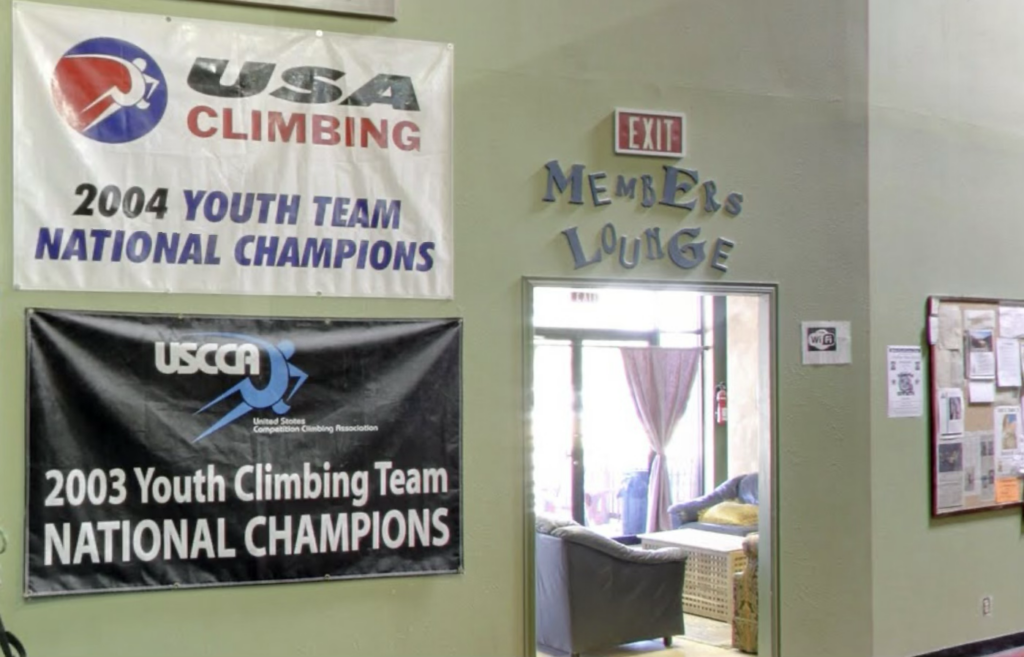
In the early days, I put in my hours as a belay slave, dutifully keeping the rope taut as she ascended entry-level routes. Soon, however, her skill eclipsed mine, and I happily retreated to the members’ lounge where I joined the other team moms and dads assembled on furniture of questionable origin — and dubious cleanliness — arranged haphazardly beneath an array of faded covers of out-of-date Climbing magazine covers. After a few months, I was as recognizable to the indifferent late-teen at the front desk as any hard-core member. I’d breeze into the gym to join my fellow climber parents, discussing plans for the latest out-of-state comps; commiserating over the difficulties of juggling team practices, schoolwork, and family obligations; and offering moral support when it all seemed overwhelming. At the end of each practice, we all had the same routine: gym bag and shoes in the back of the car and smelly climber in the rear seat, because in Texas, it is frowned upon to shut your child in the trunk.
As our kids progressed in the sport, our friendships deepened, and we grew into a tight- knit group. In many ways, we mirrored the team our children joined. We formed individual friendships, met up on the weekends, and had our own private jokes. But as a whole, we melded into a sub-genre of a fringe-sport culture, and we grooved to the idiosyncratic rhythm and beat of our children’s passion. We learned the language: beta, problem, crux, pumped. We could converse with them, albeit somewhat awkwardly. Occasionally, one or two of the parents would tire of life in the lounge and decide to give rock climbing a try. They’d rent spray-sanitized shoes, wriggle into ill-fitting harnesses, and diligently watch the mandatory safety video produced by the gym. Featuring former team members dressed ironically in 80’s-era sports gear, demonstrating the basic techniques with a David Letterman-esque zeal, the message was probably legally valid, but it certainly failed to convey the seriousness of its subject. None of this appealed to me. When asked to join, I referenced my overwhelming fear of heights as reason enough for staying parked on the couch. One of my less demure friends flatly stated she wasn’t going to attempt climbing because her “boobs would get in the way.” A fair assessment for both of us. We happily stayed in the lounge where we may or may not have snarkily critiqued the others’ climbing form.
On the whole, the parents were never truly part of our kids’ climbing group; we served mainly as observers and facilitators. Yet we were as invested in the sport as any of the participants. We watched from chalky corners as hours of dedication and effort honed bodies and morphed into triumph or heartache on the competition wall. We cheered or consoled, and felt each child’s emotion as deeply as if it were our own. It was an odd space to occupy – we were emotionally engaged in the sport, yet physically divorced from the action.
Then seemingly suddenly, after eight years of four-day-a-week treks to the gym, my daughter turned sixteen and began driving herself to practice. My days in the purgatory of the members’ lounge ceased. At first, I enjoyed my new freedom, but soon I missed being a part of it all. The climbing gym — all its dusty, musty, alt-music soundtrack vibey-ness, all the bravado and swagger, all the deep-seated grit and determination – had imprinted itself on my soul. My friends from the lounge are still my friends today, and we support each other in life outside of the gym with all the fierceness and tenacity of world-class belayers. In my own, odd, non-climbing way, I am as much a member of the rock-climbing community as my daughter.
###
Though still not a climber, Carole has earned dry, calloused hands as a ceramic artist working out of her home studio in Dallas, Texas. Her strange, beautiful, one-of-a-kind pieces tell their own stories, occasionally populating the posts of @carole.walter.ceramics. And yes, she is my mom. This newsletter supports nepotism.
Packing Tips- by Ed Pandolfino
How dense is too dense?
For the past 6 months, we’ve been trying to simplify our boulders. Less holds meant more empty space, and more empty space means…more holds on the wall? We began filling the gaps in our sets with more boulders, eventually leading us to a not new, but new to us style, of density-maxxing.
To say we have been packing it in is an understatement; we currently have 170 boulders in one of the smallest bouldering square footage imprints in New York City. An accomplishment for sure, but have we gone too far?
I want to share some insights into how we’re doing it, why we’re doing it, and what the feedback has been like.
How?
Although it looks chaotic, there is a method to the madness, and margins we have to stay in to prevent the quality of the product from being dampened.
Color Mapping:
- Traditionally, we have had a color mapping that prevents conflicting color-blind colors from being too close to each other, like red/pink, green/red, purple/blue. We have been exercising a bit more leniency in how close we put these colors together. We have been trying to make hold types on these adjacent boulders as distinguishable as possible when the colors are close to each other. It is impossible to achieve this type of density while adhering to a strict color map.
- We still continue to map in a way that places “problem” colors farthest away from each other, but the mapping spread has become much denser. When setting, we try to have these colors take more linear paths and not cross through each other. They can still exist adjacent.
More Colors:
- We have been using an additional 4 colors (purple, grey, mango, wood) to supplement our 7 standard colors (red, pink, black, slime, yellow, white, blue). This has allowed us to fill in gaps where we might not have been able to fit another boulder. Most of these extra colors consist of novelty holds or leftovers that we have had from previous projects. However, they are still useful and can be good conversation starters (see if you can spot some of them in the photos).
- I am looking to order another color this year. Originally, this was going to be teal, which would’ve been ideal from a color-mapping perspective, but it is now looking like it is going to be purple. We used to use purple many years ago and have almost phased it out due to many of the holds being outdated and not fun to climb on or set with. Purple would be “reintroduced” for boulders only as a filler color with holds that serve the v4-v8 range. This range is a sweet spot for many of our clientele. Teal is going to be implemented for a different use across Movement as a whole.
Splits:
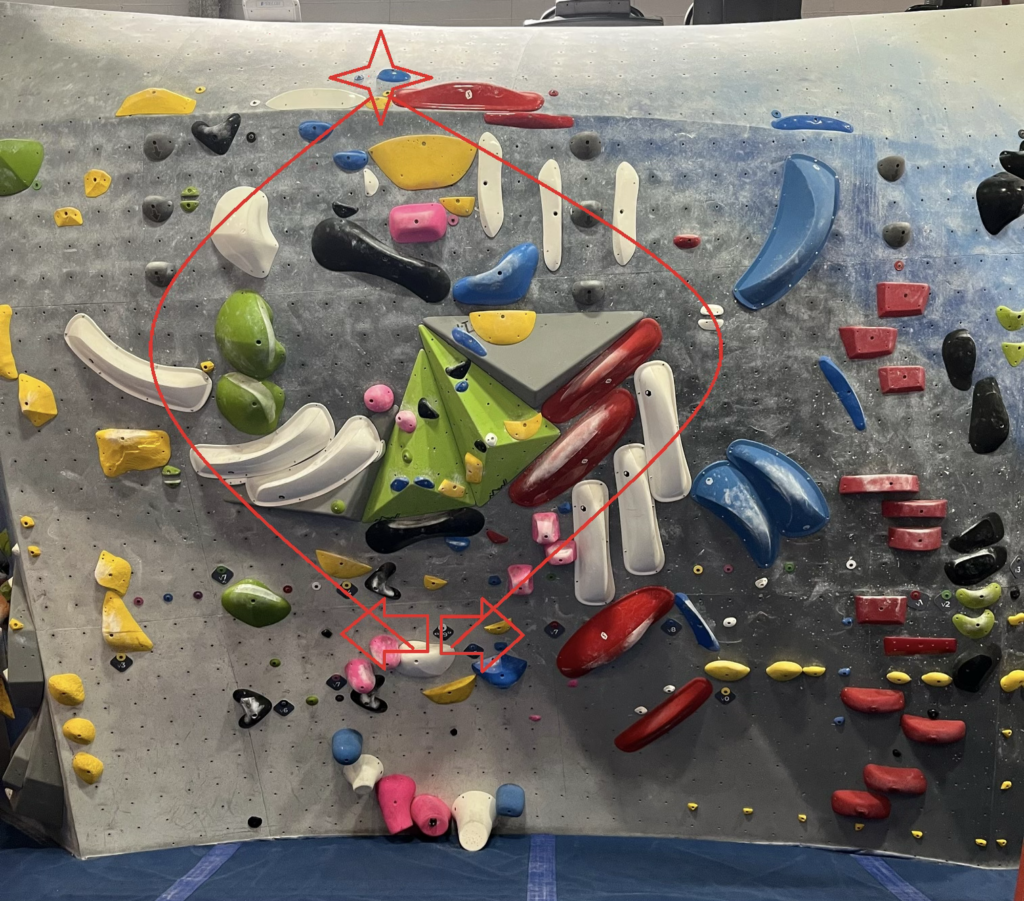
- A simple tactic that has proven very effective: have boulders of the same color start or end on a shared hold. Things can get pretty tight, and leaning into sharing starts and finishes alleviates some pressure for space. This is reminiscent of when gyms used to use tape, but it worked then and it still works now. This can also offer some visually pleasing arcs and throughlines.
Example of a split on these white boulders:
- Less often, we will set a “true” split, where boulders of the same color join halfway through, usually having different intro moves. I think this one inherently has less value, as you are climbing the same section of the boulder on “different” climbs.
Hold Profile:
- This has been the biggest learning curve in our density-maxxing journey. Large profile holds (this usually pertains more to depth) can throw off the feeling of the set. If you are dodging holds from a neighboring boulder to get to the next hold on yours, regardless of how dense the wall is, the experience changes. You want to be thinking about climbing, not completing an obstacle course.
- We have been trying to pick a hold to be our largest profile hold before we begin setting. This creates consistency in hold size across the set and helps to prevent one hold from getting in the way of 4 boulders around it. There are exceptions that are made for this rule, but it mostly consists of the supersized holds being low or high on the wall.
- This has made me much more aware of the value of certain hold types, especially lower profile high footprint fiberglass holds like the Floating Points, Bluepill Fiber-impressions or Secret Comp.
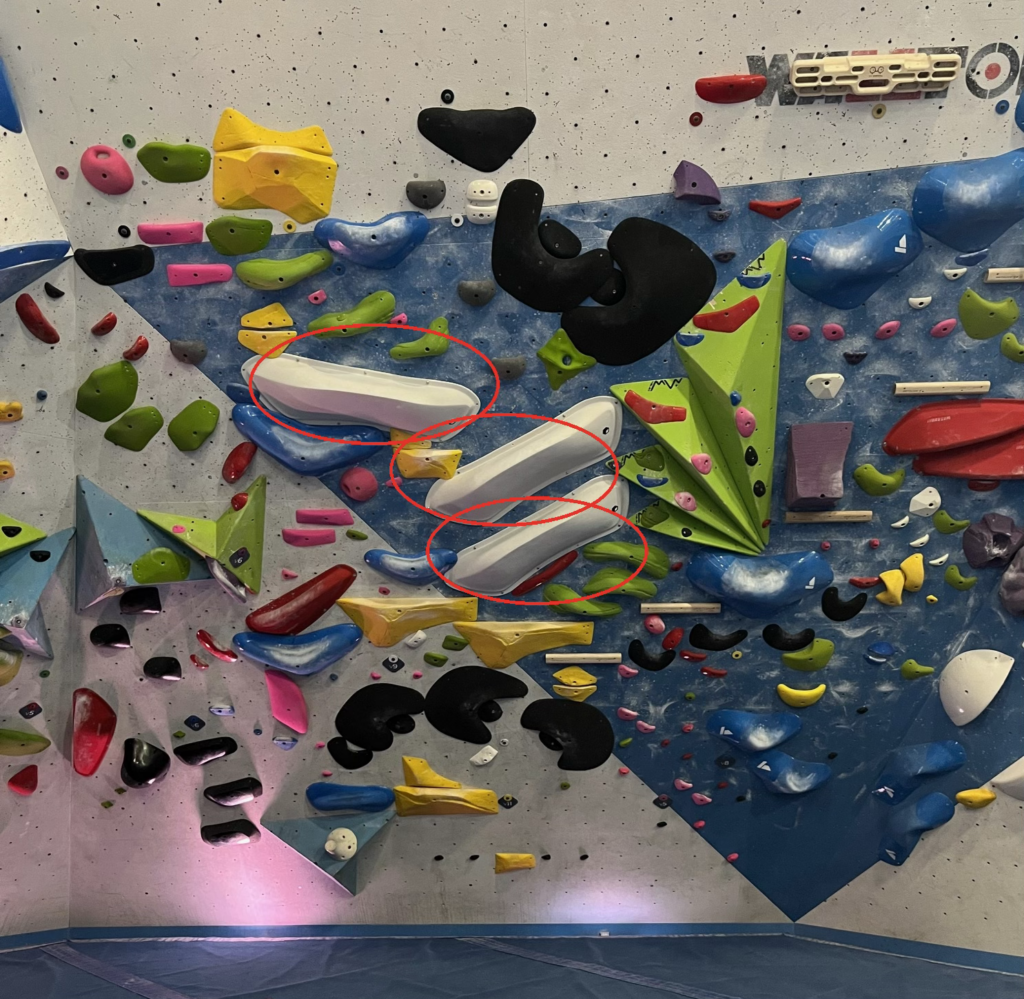
Flathold Borderlines are an example of a hold that can be difficult to set around. There is a low density area of holds directly above them because of this:
Setting:
- Simplicity is king. We are setting a lot of boulders, with zones often getting 25-35 total boulders. Forerunning is easy when you’re not trying to reinvent the wheel. This has kept a slightly higher forerunning quota manageable. I feel that we are putting up quality, repeatable boulders. However, this does leave less room for experimental movement. We have been slowly introducing more “new school” style movement in these density-maxxed sets to varying degrees of success. We are still working on this one.
- Empty space dictates movement. When you are trying to fill as much of the wall as possible, the lines to follow become more defined. Filling in the gaps keeps movement unique, and keeps us resourceful in our solutions. A few of our favorite boulders were born out of a squeezed lane.
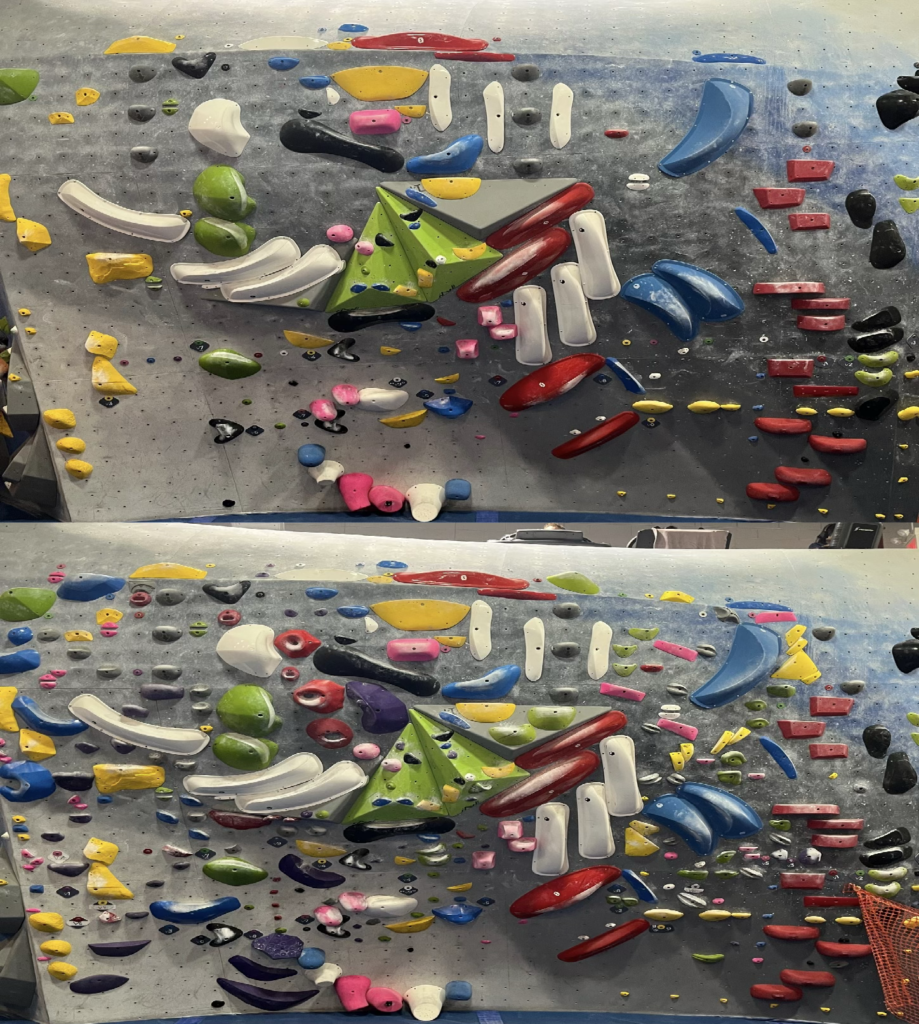
How empty space gets filled:
Why?
After mulling this over, it’s come down to two reasons.
We are a non-modern gym trying to offer a modern product. LIC is entering its 12th year of existence, and many of the climbing facets of the gym are outdated. Fiberglass walls, questionable wall colors, and an inclination towards steep terrain have become things of the past in newer gym designs. For a long time we have been trying to produce modern routesetting in a non-modern space. This task hasn’t proved to be impossible, but it has felt more constricting to force the space to fit a climbing style it wasn’t designed for. Volume-heavy boulders can often kill a large portion of a zone, and modern-style foot coordination is a tall order due to our only “slab” panel being 20 feet. We can do it, but it’s forced.
Most gyms have moved away from super high density. This is because most new spaces don’t necessitate any need for this. Bouldering gyms accounted for over 70% of new gym growth in 2024, according to CBJ. I would wager a guess that a majority of these gyms have double, if not triple the amount of bouldering space of LIC. This has changed the format of setting to a more sprawling landscape, which I think is better. However, we view this as an opportunity to differentiate ourselves in a market that is beginning to look overwhelmingly the same in terms of options. I recently discovered a quote emblazoned on the landing page of Arrowhead Game Studios (developer of Helldivers) website, reading “A game for everyone, is a game for no one.”
As we are an older gym in a highly competitive market, we feel it’s paramount to offer a distinct setting experience. Density might not be for everyone, but it has to be for someone.
Feedback:
Do people like it? So far the response has been overwhelmingly positive, but no system is perfect.
Pros:
- “I have so many options!” This has been the most common response, and the one that I think about the most. While we do love providing options and giving people multiple things to work on in different styles, I do think the boulders we are providing, from a routesetting perspective, are slightly lower quality than the ones we provided when the gym was at lower density. There is a discussion to be had about where the diminishing returns are met with climber experience and how much time we put into setting/forerunning a boulder, but the short of it is that it’s something I think about now more than ever. Right now, I do feel that climbers value more options which raises their potential success rate than fewer options that require multiple sessions to decipher.
- “The walls look dense.” A picture is worth a thousand words, and your first view of a boulder set is worth a few. If a climber sees a lot on the wall, they will be attracted to it. They want to see what’s new, what’s for them, what’s for their friends, and what they can work towards. The walls at LIC right now, for lack of a better word, look crazy; some of them look like you wouldn’t be able to fit another boulder on them if you tried. For some, density equals value: “If I have a lot of options, wouldn’t I keep coming back?”
- “Hey, have you tried that one yet?” It has become hard to find, or climb every boulder in your range on your first visit to the new set. From fly-on-the-wall viewing to participating in a session, this conversation has come up more often than ever, which restores a bit of the community aspect that has been fading in climbing gyms. It’s a special feeling to guide and work with someone on something they haven’t tried before.
- “The rotation is fast!” At the beginning of last year, my assistant manager, Hans, had the idea to change up the boulder zones/rotation. This effectively made every zone bigger, but we set boulders over the course of 3 days, splitting the team between ropes and boulders. We have made some modifications to this since but it has largely stayed the same. This has put our rotation (excluding our upstairs boulder mezzanine) at roughly 5 weeks. Initially we were doing it in 4 but this was a bit too fast.
Cons
- “I had to dodge that hold.” Common, unavoidable, but controllable. This has been a bit of a learning curve for us as to where we can be putting larger holds to not interfere with the climbing experience. As mentioned in the hold profile section, we have been opting for lower depth holds and trying to be highly aware of where large features and volumes are ending up on the wall. However, there will always be some element of this that comes with the territory. In my own climbing sessions, I usually have the most frustration with having a hard time finding places to smear on the wall. I think this is something we have room to improve on.
- “Is this sustainable?” I’m not really sure. Right now, it feels sustainable from a setting and forerunning standpoint because we usually cycle out members of our team on the boulders each day, so no one is setting boulders two days in a row. Some of the filler days can be difficult with 5-7 boulders per-setter going up, but the limited canvas usually airs toward the side of simplicity. We have been doing this for 5-6 months and haven’t noticed a huge shift in overall workload, but this could change depending on how we skew our grade spread.
Our current spread, a majority of our core climbers find themselves in the v4-v7 range. We are looking to add/move a few boulders in the v0-v2 range.
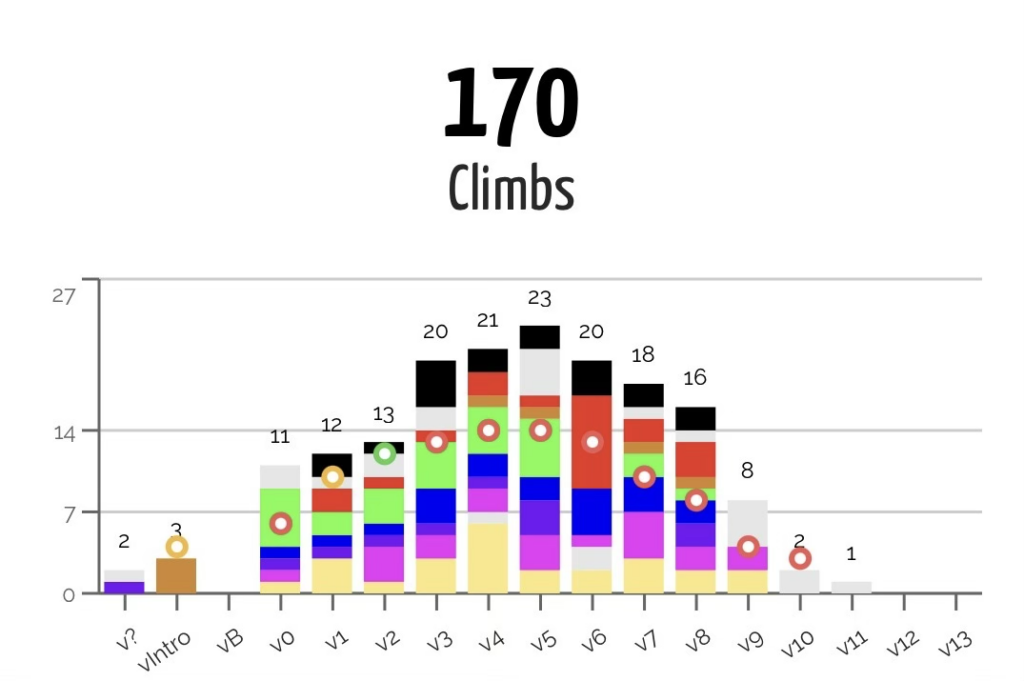
- “Are we setting a standard we can’t go back on?” I feel that we have always set high standards to uphold in LIC. Would it be shocking to go back down to 120 boulders? Definitely. Is it more likely for us to fluctuate between 140 and 160? Probably. The numbers have changed quite a bit per-rotation over the past few months and we haven’t noticed a drastic difference in climber perception. I think what we have right now is especially high, but if a few boulders were missing no one would bat an eye.
I think it’s important to note that this is a snapshot of how we’re feeling/doing things in the current moment. The setting at LIC has gone through many phases, and this is the current one in the cycle. It’s not better or worse than what anyone else is doing, it’s just different. If you asked me how I felt about this hyper-density a year ago I probably would’ve had a much different outlook on it. However, a zig while others are zagging feels empowering.
###
Ed is the head setter at Movement Long Island City and writes a fantastic newsletter chock-full of setting insight and immensely pleasing graphics, which you can find on Substack under the handle @eptsets
Some Things Never Change- by Callie Walter
Outside, a small boy with blond curls pauses on the busy sidewalk. He totters to the window and cups his hands around his eyes to peer in at the tizzy of booms, lighting tripods, camera crews, and sixteen of the world’s best climbers strewn between couches and crashpads. His breath begins to fog the glass before his mother comes to take his arm and hurry them along; a soft drizzle is beginning to fall in the streets of Wandsworth.
The athletes have just arrived at the Font 2.0, a climbing gym in southwest London, for the morning’s press block. Bright grey light filters through the large windows and is then blocked almost immediately by a wall of Moon and Kilter boards, creating a sort of gloomy media-cave where dozens of people tote equipment and scrounge for outlets. It will be a long day with a slow start.
Danaan Markey, co-founder of the Pro Climbing League, gets the room’s attention to explain the conveyor belt of photoshoot and interview stations. The athletes will pose for the Red Bull cameras, sit for video interviews, do the same things with the PCL’s crew, and finally film with the content creators. Once all the gadgetry has been cleared off the mats, they can start warming up for tonight’s seed round. These rankings will determine who climbs against whom tomorrow evening on the stage of Magazine London, when the athletes will be pitted against each other in the first round of this brand-new, dramatic, head-to-head, knock-out-style competition, with only the fastest and the fiercest advancing on to the Semifinals. On a couch piled with climbing bags and jackets, Oriane Bertone is braiding Anon Matsufuji’s hair.
The circuit begins, and I try to stay out of the way, standing behind a cooler shaped like a giant Red Bull can and using its lid as a desk to take notes. Such a variety of people are here—beyond the production crews, there are COO’s of gyms, social media managers, heads of brand strategies, and a climbing mental health expert. Everyone has been drawn to this event, pulled in by the curiosity of what it might bring, what it might mean to their piece of climbing. The chatter is almost all excitement, with a razor edge of nervousness. So much about this event will be unknown, untested, and unproven until the lights go down tomorrow night.
By the time morning has slogged into afternoon, I’ve heard three different start times for the seed-round: one person said five o’clock, another thought four, and a hopefully misinformed third was sure it was seven pm. During a lunch-time lull, I join the corner of people who have pulled out their laptops to answer emails, edit posts, or type up notes. Bryn Lucas— who will co-commentate tomorrow’s livestream alongside Shauna Coxsey—sits down next to me. His notepad is covered in jottings, scratch-outs, and question marks. He’s a presenter for Red Bull, well used to covering live sports and TV events, but he’s getting a crash course in the climbing world.
“I just spoke with Jenny Buckley, and it was more like she was interviewing me,” he says, looking a little dazed. “She wanted to know everything about running a YouTube channel, making money off of videos, how sponsorships work… I’ve never been asked so many questions in my life.”
Glancing around, I think this must be the first time that a press-junket of this magnitude has been conducted before a climbing competition. For some of the younger athletes, like Jenny, this is likely the most professional media exposure they’ve ever received. As a sport, today’s climbing has an audience that has never existed before: millions of people have fallen in love and want to see it take a big swing. By the door, Max Milne is playing with a wooden cup-and-ball toy, but is flinging it around backward, trying to catch the socket on the ball. The hefty, mallet-shaped wood whips over his shoulder, missing his head by centimeters.
“Oh my god, did you see that?” Max giggles, looking over at our laptop corner. “I nearly knocked myself out!”
The climbers seem to be handling the new stressors authentically.
When the investors start arriving, it’s confirmed that climbing will begin at five. The seeding round is private, invitation-only, for press and VIPs. I chat with one of the men who’s put money into the PCL, and he tells me about his vision for climbing’s future: brand-sponsored teams, with personal physios, coaches, and setters all devoted to elite athletes, who would rep the brand’s kit during high-octane competitions.
“Oh, like NASCAR,” I say brightly as the concept clicks in my head.
He takes a polite beat before responding, “Or, you know, Formula 1.”
Out the windows, the light is failing, and the crowded room is emptying; people find their way upstairs where the setters have finished the final tweaks on the women’s problems. Four boulders wait for the eight athletes warming up behind the plastic tarp that delineates iso from tonight’s stage. Spotlights dot the wall, framing the vinyl banners of the PCL and the Font. I stand on a chair and watch as Camilla Moroni, Anon Matsufuji, Lucia Dörfell, Jenny Buckley, Annie Sanders, Erin McNeice, Oriane Bertone, and, of course, Janja Garnbert walk across the mats, smiling for the crowd. They are Olympians, World Champions, and perhaps, the ushers of a new age for competitions. It’s captivating to watch them perform in such a small space, to feel the attitude of their movements so close at hand. No one enters a room like Orianne. No one commits to the wall like Annie. No one intoxicates the air like Janja.
A DJ pumps electronic music over the crowd as the women dispatch the slab, the electric, and the power boulders, their placements getting separated largely by attempts. The audience is small but loud, screaming each athlete’s name as they take to the wall. There’s an undeniable alchemy to the assembly of people in this room: many with shared, intermingled pasts, who have waited, consciously or not, for years, or maybe even decades, to be pulled here together, to witness something new and big.
The women’s round is nearly over, with Oriane crouching into the crowd-facing start of the fourth boulder, when the lights cut out, and the music stops. The spectators pause for half a second, then yell even louder and point phone flashlights at the wall. Orianne sticks the first move, and the lights surge back on just long enough for us to cheer, then immediately groan and laugh when they go dark again. Someone spilled Red Bull on an extension cord. I have to smile. For everything that will—and should— change as our sport grows up and out, climbing is still climbing. “
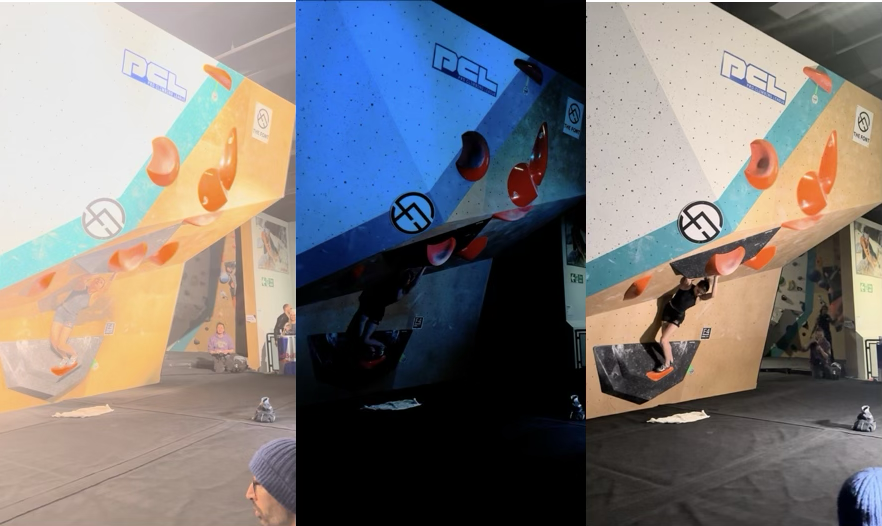
“Some Things Never Change” is an excerpt from the piece I wrote after hanging around the PCL. The full story will be published in the next edition of Vermin, so make sure to follow @verminworld and check it out in print soon!

Until next time!
Submit your indoor climbing stories to Gym Rat by emailing writing, photos, or artwork to gymratnewsletter@gmail.com !